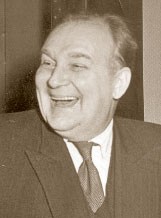
Who was this Valery Kosolapov, and why should I write about him—and you read about him?
Valery Kosolapov became a righteous man for a single night, and had he not, we would not have known Yevtushenko’s poem “Babi Yar.” Kosolapov was indeed the editor of Literaturnaya Gazeta at the time, which published this poem on September 19, 1961. And this was an act of genuine civic courage.
After all, Yevtushenko himself admitted that these verses were easier to write than they were to print in those days. The story of its writing is connected to the fact that the young poet met the young writer Anatoly Kuznetsov, who told Yevtushenko about Babi Yar. Yevtushenko asked Kuznetsov to take him to the ravine, and he was completely shattered by what he saw.
“I knew there was no monument there, but I expected to see some kind of memorial marker or at least a tended spot. And suddenly I saw the most ordinary landfill, which had been turned into a sandwich of foul-smelling trash. And this was on the very spot where tens of thousands of innocent people—children, the elderly, and women—lay in the earth. Before our very eyes, trucks were driving up and dumping new piles of garbage onto the place where these victims lay,” recounted Yevtushenko.
He asked Kuznetsov why there was a vile conspiracy of silence around this place. Kuznetsov replied that it was because about 70 percent of the people who participated in these atrocities were Ukrainian policemen who collaborated with the fascists, and the Germans gave them all the dirtiest work involved in the murder of innocent Jews.
Yevtushenko was simply stunned—as he put it, so “ashamed” by what he saw—that he composed his Poem in a single night, and on that night, he was undoubtedly a righteous man. In the morning, he was visited by several poets led by Korotich, and he read them the new verses; later he called others... someone “snitched” to the Kyiv authorities, and they wanted to cancel Yevtushenko’s concert. But he did not give up and threatened a scandal. And that evening, “Babi Yar” was heard in the concert hall for the first time.
“There was a minute of silence there; it seemed to me this silence was endless. Then a tiny old woman came out of the audience, limping, leaning on a stick, and walked slowly across the stage to me. She said that she had been at Babi Yar, she was one of the few who managed to crawl out through the dead bodies. She bowed deeply to the ground before me and kissed my hand. No one had ever kissed my hand in my life,” recalled Yevtushenko.
Then Yevtushenko went to Literaturnaya Gazeta. Its editor was Valery Kosolapov, who had replaced Tvardovsky himself in this post. Kosolapov was reputed to be a very decent and liberal man, naturally within certain limits. His party card was with him, for otherwise he never would have found himself in the editor-in-chief’s chair. Kosolapov read the verses right in front of Yevtushenko and, with deliberation, immediately said that the verses were very strong and necessary.
“What shall we do with them?” Kosolapov wondered aloud.
“What do you mean?” Yevtushenko pretended not to understand. “Print them.”
Yevtushenko knew perfectly well that when people said “strong verses,” they immediately added: “but they cannot be printed right now.” But Kosolapov looked at Yevtushenko sadly and even with a certain tenderness. As if it were not his decision.
“Yes. He reflected and then said, ‘Well, you will have to wait, sit in the little hallway for a bit. I’ll have to call my wife.’ I asked, ‘Why do you need to call your wife?’ He said, ‘It must be a family decision.’ I was surprised, ‘Why a family one?’ And he told me, ‘Well, how can it be otherwise? I will be fired from this post when this is printed. I must consult with her. Go, wait. Meanwhile, we will send it to be typeset.’”
Kosolapov knew perfectly well that he would be fired. And this meant not just the loss of this or that job. It meant the loss of status, falling out of the nomenklatura. The deprivation of privileges, rations, passes to prestigious sanatoriums...
Yevtushenko grew worried. He sat in the hallway and waited. The wait dragged on, and it was unbearable. The poem instantly circulated through the editorial office and the print shop. Ordinary print shop workers came up to him, congratulated him, shook his hand. A little old typesetter came. “He brought me a started half-pint bottle of vodka, and a pickled cucumber with a piece of black bread. This old man said, ‘Hold on, you just hold on, they’ll print it, you’ll see.’”
And then Kosolapov’s wife arrived and locked herself in his office with him for almost an hour. She was a large woman. At the front, she had been a field medic; she had carried many from the battlefield on her own shoulders. And so this grenadier of a woman comes out and approaches Yevtushenko: “I wouldn’t say she was crying, but her eyes were a little wet. She looked at me searchingly and smiled. And she said, ‘Don’t worry, Zhenya, we have decided to be fired.’”
Listen, that is simply beautiful. That is powerful: “We have decided to be fired.” It was an almost heroic deed. Only a woman who had walked under bullets at the front could manage not to be afraid.
The troubles began in the morning. People arrived from the Central Committee screaming: “Who let it through? Who missed this?” But it was already too late—the newspaper was selling out with might and main at the kiosks.
“Within a week, about ten thousand letters, telegrams, and radiograms arrived, even from ships. The poem spread simply like lightning. It was transmitted by phone. There were no fax machines back then. They called, read it, and wrote it down. People even called me from Kamchatka. I asked, ‘How did you read it? The newspaper hasn’t reached you yet.’ ‘No,’ they said, ‘they read it to us over the phone, and we wrote it down by ear,’” said Yevtushenko.
At the top, of course, they took revenge. Articles were organized against Yevtushenko. Kosolapov was fired.
Yevtushenko was saved by the reaction in the world. Within a week, the poem was translated into 72 languages and printed on the front pages of all major newspapers, including American ones. Within a short time, Yevtushenko received 10,000 letters from different corners of the world. And, of course, grateful letters were written not only by Jews. Far from only Jews. The poem touched many. But there were quite a few hostile actions as well. They scratched the word “Yid” [zhd] on his car; threats poured in.
“Some huge guys from the university, tall as basketball players, came to me. They took it upon themselves to voluntarily guard me, although there were no incidents of attack. But there could have been. They slept on the staircase landing; my mother saw them. So people really supported me,” recalled Yevtushenko. “And the most important miracle—Dmitri Dmitrievich Shostakovich called. My wife and I didn’t believe it at first; we thought some hooligan was calling, pulling a prank on us. He asked me if I would give permission to write music for my poem.”
...This story has a good ending. Kosolapov accepted his dismissal with such dignity that the party pack got scared. They decided that he was so calm because someone was surely standing behind him. And after some time, they brought him back and put him in charge of the magazine Novy Mir. “But the only thing standing behind him was his conscience,” Yevtushenko concluded. “He was a true Human Being.”
Sources:
-
The story about editor Kosolapov, his wife, and the phrase “We have decided to be fired” is described in detail in Solomon Volkov’s book “Dialogues with Yevgeny Yevtushenko.”
-
Yevtushenko told this story in numerous interviews (for example, to Dmitry Gordon and in the program “Visiting Dmitry Gordon,” as well as in an interview with “Novye Izvestia”).