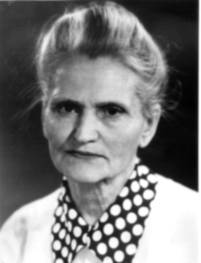
Oksana Meshko stands as the personification of 20th-century Ukrainian resistance. Her journey began on January 30, 1905, in the Poltava region, in the village of Stari Sanzhary. Born into a humble family of land-poor peasants, she absorbed the freedom-loving Cossack spirit from early childhood; her ancestors had managed to preserve their personal liberty and avoid the yoke of serfdom. This ancestral pride and sense of self-worth would later become the bedrock of her human rights advocacy.
A Family Tragedy in the Gears of Revolution
The Meshko family found itself in the crosshairs of the repressive state machine long before the mass purges. Oksana’s relatives belonged to various national movements—from the UNR (Ukrainian People’s Republic) to the OUN (Organization of Ukrainian Nationalists). The first profound loss came in 1920, when the Bolsheviks executed her father at Kharkiv’s Kholodna Hora for tax “sabotage.” Her eldest brother, Yevhen, a cultural activist and insurgent in Ataman Bilenkyi’s unit, fell in battle near their native village. Soon after, the family was dekulakized and their home seized. The four children—Oksana, Ivan, Vira, and Kateryna—were forced to go their separate ways. Kateryna’s fate eventually led her to the United States, and her son, the renowned economist Yuriy Logush, would provide vital support for Oksana toward the end of her life.
Forging Character and the First Prison Sentence
During the 1920s, Oksana strove to obtain an education. Despite the obstacles posed by her “incorrect” social origins, she repeatedly fought for reinstatement after being expelled and eventually graduated from the Faculty of Chemistry in Dnipro (then Dnipropetrovsk). It was there she met her future husband, Fedir Serhienko, who had already experienced repression for his Ukrainian convictions.
The bright chapter of their married life was short-lived. Stalinist terror and the Holodomor turned mere survival into a daily act of heroism. After nine months of disappearance, Fedir was released, but only at the price of forced cooperation with the Chekists. Together, they made a difficult but honorable decision: her husband fled to the Urals to avoid becoming a tool in the hands of executioners, leaving Oksana with two young children.
World War II and the Stalinist Hell
The war brought Oksana a devastating loss: her firstborn son, Yevhen, was killed during a bombing. It was only after the liberation of Kyiv that the family could reunite in the Ukrainian capital. However, the true trials began in the post-war years. Oksana gave shelter to her sister Vira, whose family had been decimated by the regime for ties to the UPA (Ukrainian Insurgent Army). A neighbor’s denunciation proved fatal: both sisters were accused of a nonsensical conspiracy—“plotting an assassination attempt on Nikita Khrushchev.”
In 1947, exhausting interrogations began. Meshko recalled how her 15-year-old son, Oles, wept upon hearing her sentence: 10 years in the camps. Oksana was transported to Ukhta. Years spent in stone quarries amidst inhuman abuse and bitter cold nearly drove her to suicide, but she found salvation in solidarity with other female political prisoners from Western Ukraine. This camp-born “sisterhood” restored her will to live.
Spiritual Leadership and the Founding of the UHG
In 1956, after Stalin’s death, Oksana Yakivna was rehabilitated, receiving a cynical wish for happiness from a colonel of justice. Her answer to the regime was her memoir “Between Death and Life” and her active participation in the Sixtiers (Shistdesiatnyky) movement.
The second wave of repression in the 1970s did not spare her son, Oles, who received a lengthy sentence in the Perm labor camps for his stance. In 1976, Mykola Rudenko invited Meshko to help found the Ukrainian Helsinki Group. In her seventies, she became the organization’s driving force, leading fellow dissidents to respectfully dub her the “Cossack Mother.”
The Final Challenge to the System
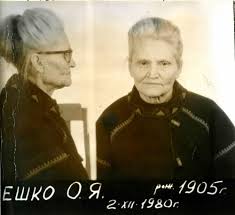
The Soviet authorities tried to break the elderly woman through punitive psychiatry and another prison sentence. At the age of 76, she was sent into exile to the frigid shores of the Sea of Okhotsk—a grueling 108-day journey to the Khabarovsk Krai. Yet, she returned to Kyiv undefeated.
During the years of Perestroika, Oksana Meshko visited Australia and the United States, speaking in parliaments and before Congress to share the truth about enslaved Ukraine with the world. She personally opened the founding congress of the Ukrainian Republican Party in 1990 and supported the hunger-striking students on the Maidan during the Revolution on Granite.
Oksana Yakivna passed away on January 2, 1991. She left this life only a few months before the declaration of the long-awaited Independence. Today, her grave at the Baikove Cemetery, marked by a traditional Cossack cross, stands as a monument to an era when the dignity of a single woman proved more powerful than an entire totalitarian empire.