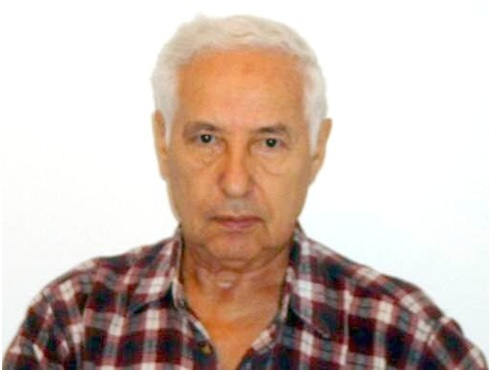
Whose memory of Babi Yar is it, how Soviet power turned Jews into Zionists, and what the future of Ukrainian-Jewish relations looks like — about this and much more, a conversation with Emmanuel (Amik) Diamant, the organizer of the first rallies at Babi Yar, a former activist of the Jewish national revival in Kyiv, and a rueful nonconformist in today's Israel.
— Emmanuel, for you Babi Yar began in August 1961, when Yevtushenko first read the poem that was to become famous at an evening of his work at the October Palace. Why did those lines meet with resistance back then?
— I loved Yevtushenko very much; he was my idol at the time, and the audience, I must say, was thrilled by “Babi Yar” — but I wasn't, not really… The thing is that six months earlier the Kurenivka disaster had revived the memory of Babi Yar in the public consciousness. But the ravine itself — which Soviet power had until then been barbarically obliterating — had been turned into an enormous construction site, where, in the course of the earthmoving work, Jewish bones were mixed in with sand, clay, and building materials. All of this stayed outside Yevtushenko's frame; he slyly failed to notice any of it and left it out of his poem.
At that time a poem called “Babi Yar” by the young Yuri Kaplan was circulating from hand to hand in Kyiv — people were afraid even to copy it out, they passed it on by ear, from memory — and it made a far stronger impression on me.
Even so, I am deeply grateful to Yevgeny Alexandrovich for his Act — he was the first to say out loud, in public, the words “Babi Yar,” which had been taboo until then. For many people it was like a bolt from the blue. As for me, after that evening at the October Palace I understood that from then on I was personally answerable for everything happening around me — both with Babi Yar and with the Jewish people in general. Because there was no one else. Because I might be the last Jew on the planet who still cared…
And so I picked up a camera and went out to take pictures — today this is the only surviving evidence of what was happening at Babi Yar in August 1961. In March 1971 I managed to get that archive out to Israel.
— The organizing of the first rally at Babi Yar — on September 29, 1966 — is sometimes linked with the name of Viktor Nekrasov. I know you don't much like talking about this, but in fact there were two rallies — on the 24th and the 29th — and both were organized by you. It's simply that the second one took place with the participation of Nekrasov and Ivan Dziuba.
— What happened on September 24 is hard even to call a rally — it was the first public action at Babi Yar. There were only about five or six direct organizers and instigators. Toward evening on September 24, Garik Zhurabovich and I hung a banner on the remains of the wall of the former Jewish cemetery; it read, in Hebrew and in Russian: “Babi Yar. September 1941–1966.” And above that, in Hebrew: “Yizkor (remember) 6,000,000.” After that we cleared out immediately. Garik Goldovsky and Grisha Pipko then appeared near the “poster”; their job was to make sure no one tore it down before the first people arrived.
There is footage shot by the cameraman Eduard Timlin that day — Nekrasov against the background of the banner we had hung. Did he letter the Hebrew inscriptions himself? Or have someone else do it?
Rafa Nakhmanovich, a director at the Kyiv Documentary Film Studio, who was the one who brought Nekrasov to that rally, later recalled it this way: “…a friend of my wife's came and told me that some young Jewish fellows were going to mark the anniversary of the shootings at Babi Yar. …The first thing I did was go to Viktor Platonovich and tell him about it. He caught fire, of course, since this subject — what Soviet power was doing at Babi Yar — troubled him a great deal.”
These days the idea is being pushed hard that Babi Yar is a grave of all humanity and that the struggle for the memory of Babi Yar was always a concern of all humanity. But now that the KGB archives are open, it is easy to check which surnames appear in the KGB reports in connection with the organizing of this and subsequent rallies at Babi Yar. Nekrasov and Dziuba are mentioned exactly once, in the report of 09/30/66, and right alongside the “Jewish nationalists.”
— In 1967, after the Six-Day War, the Zionist movement in the USSR began to rise. How well did the struggle to commemorate the victims of Babi Yar fit into that trend, given that it had no direct bearing on the fight for free emigration, the study of Hebrew, and so on?
— The Jewish national revival began after the Twentieth Party Congress, and the Ukrainian KGB always called us, quite accurately, “Jewish nationalists.” Moscow, from the end of the 1960s, labeled us exclusively as “Zionists” — and that, too, was not without reason. You simply have to understand that it was Soviet power that made us Zionists!
When the Six-Day War broke out, Israel was declared the aggressor, and every Soviet Jew had either to denounce the invaders (thereby demonstrating solidarity with the authorities) or… become an unwitting accomplice of the Israeli aggressors. In this way the entire Jewish national movement was shoved into Zionism — though by no means all of us wanted that at the time.
The mood and the state of mind of the masses are perfectly captured by a joke from that period: The police pick up a drunk who has beaten up a Jew near the metro. “What's going on, citizen, what happened?!” “Well, Petrukha and I sat down for a little morning refreshment. Poured a round, drank it. And on the radio they announce: the Israeli aggressors have attacked our friend Egypt! So we poured another round and drank it — and the aggressors, we hear, have already taken the whole Sinai. In the morning we got up for a hair of the dog. We come out of the metro — f—, they're already here! So we let him have it…”
In that period Babi Yar became one element of the struggle of all nationally minded Jews for the honor and dignity of their people, for the right to protect the honor and dignity of Jewish graves defiled by Soviet power, and, in the end, for the right to leave that country for their historical homeland — the State of Israel.
— As far as I know, you applied to emigrate in the summer of 1969…
— In May 1968 the government of the USSR decided to permit fifteen hundred Jews to leave for Israel — the sick, the lame, those without higher education, and so on. From that moment it became clear to everyone that it was possible to get out of that country! In the Baltics and in Western Ukraine people began receiving permits. And with every departure came requests to send new invitations for family reunification. In 1968–1969, 3,264 people left for Israel, taking with them 11,817 requests for reunification.
Nehemiah Levanon, the head of Nativ, recalls that a quiet panic set in in Israel at that point. Many of these people had no relatives there at all, and an invitation is a notarized legal document under which a relative undertakes to care for the new arrivals. If this avalanche of requests from prospective immigrants was a KGB provocation, Israel was in for an international scandal. The problem was handled at government level: at state enterprises they selected reliable people willing to attest before a notary (that is, to lie) that the applicants were their close relations.
In the spring of 1969 I received my invitation as well. Nobody knew what to do with it, including the staff of OVIR. Gradually the requirements began to come to light, and at work I was given a character reference that read as though I were being nominated for a State Prize. The head of OVIR looked it over and said: “You're not going anywhere. Go back to work. We need people like you ourselves.”
So I went. I got results and filed three patent applications. I received a certificate for one of them and a bonus of fifty rubles — life went on as usual. But on June 15, 1970, a group of Jewish “heroes” attempted to seize an airplane in order to escape to Israel. In January and February 1970 this idea had been discussed in every cell of the country's young Zionist organization and had been rejected by absolutely everyone. But the KGB liked it very much — this way they could sweep up every Zionist in the USSR at once, which is why a special Smolnoye–Priozersk flight was even laid on for the would-be escapees. At zero hour they weren't even allowed near the plane, but that same day thirty-five other Jewish activists were arrested across the Union — the authorities were preparing a large-scale show trial to crush the Zionist movement in the USSR.
That wave did not reach Kyiv, but around August the secretary of the party organization at the Main Astronomical Observatory (MAO of the Academy of Sciences of the Ukrainian SSR), where I was working at the time, called me in and… invited me for a walk in the woods — the observatory was located in Holosiiv. And there in the woods, where no one could see or hear us, he told me: “Amik, the district party committee is demanding that we hold a meeting and expel you from the observatory. We keep explaining that in a collective like ours that is impossible. But they insist. So I ask you, I beg you — don't make waves.”
On the eve of September 29, 1970, the director called me in — they were requiring him, he said, to keep me at work that day. Here is the order: on September 29, from 12:00 to 24:00, you are appointed duty officer of the observatory. Sign it, and please: don't go looking for trouble. And I didn't — everything had already been arranged, so the rally at Babi Yar that year took place without my personally being present.
The trial of the hijackers, which ended with death sentences for Kuznetsov and Dymshits and enormous prison terms for the rest of the accused, and above all the preparations for trials against those who had been principled opponents of the hijacking, provoked an unprecedented wave of protest both inside the Union and abroad. And at some point the authorities flinched, deciding to rid themselves of all the Jewish activists and throw them out of the Union in one stroke.
In March 1971 I was summoned to OVIR and asked to leave the territory of the Ukrainian SSR within ten days. And to take all my relatives with me. After all, I had applied to emigrate alone — without my wife, children, or parents. No one knew in advance how it might all end — you apply to go to Israel and end up in Vorkuta. When I came for the visa, the OVIR staff were dumbfounded: your wife hasn't even filled out an application form! We had to fill one out in a hurry…
— Your first impressions of Israel? Shock, delight, disappointment?
— We had only a vague idea of where we were going and why. I remember an argument that flared up in May 1968, a few days after we celebrated Israel's Independence Day in the Holosiiv woods. At a meeting of the Kyiv activists a question came up: one of my “fighters” had asked for a leave of absence from Zionist activity because he wanted to defend his candidate's dissertation (repatriation was not yet even on the table). Many were categorically opposed — no professional careers and no leaves of absence, only Zionist work! I tried to reason with them, saying that a Jewish country would need specialists. Not a chance! “We'll herd camels, we'll milk cows!” some of the girls declared proudly. That was how they pictured our future in Israel. And that is the frame of mind in which we arrived.
— Back then, in the early 1970s, you tried to create in Israel what later came to be called technology greenhouses, and today startup incubators. A revolutionary idea. Why did it never come to fruition?
— In April 1970 we carried out an amateur socio-demographic study of the Jewish population of Kyiv. It turned out that 10% of Kyiv's Jews were engineers, 4% teachers, 5% doctors, and so on. A sample census conducted a year later among the new immigrants themselves showed roughly the same proportions. It followed from this that the first hundred thousand immigrants would bring with them 10,000 engineers, and so forth. By way of comparison, in all of Israel in 1971 there were 9,000 engineers. It became clear that professionally there was nothing for us to do in Israel, and that a solution to the employment problem had to be found urgently.
We wanted to create something like what in those years in the United States was called Boston's Route 128 — a highway in the Boston suburbs along which the first harbingers of the future high-tech industry had settled. But without government contracts this was impossible. At the top they didn't really grasp it — we had two meetings with Golda Meir and conversations with Moshe Dayan and Shimon Peres. They appreciated our enthusiasm, but all they could offer was for us to go off to a kibbutz and plow the land (at least it wasn't herding camels). That was how this country had been built — it was the only experience its leaders of that time knew; they had never heard of Boston's Technology Corridor, and Silicon Valley was out of the question. Even Peres — the father of the Israeli nuclear program — could offer us nothing more than a helicopter plant in Kiryat Shmona; in his understanding that was our ceiling. And we, with our experience of serving a great nuclear power, expected to work in applied science — in what today is called high technology. The time for that came about ten years later, when the state launched the Lavi fighter project, out of which all of Israel's high-tech industry later grew. The Lavi and the arrival of the new wave of immigrants in the 1990s served as the launching pad for the technological miracle we are witnessing now, but in the 1970s the country was not ready for it.
— Did you personally manage to find fulfillment in Israel, both professionally and in public life?
— Professionally, yes — after the failure of my settlement-building efforts I worked for fifteen years at the nuclear research center in Nahal Sorek, I hold several patents, so on the whole I can't complain. As for public activity, Babi Yar was always our memory and our concern, even in Israel. In 1976 — for the tenth anniversary of our first rally at Babi Yar — we decided to invite Nekrasov to our annual memorial rally on September 29 in Israel. Viktor Platonovich was living in Paris, and money was tight for him, and for us as well. So I secured a meeting with Abba Eban in order to lobby for Nekrasov to be invited at the state's expense. Eban was no longer foreign minister, but he had retained enormous influence, and in the end his recommendations settled the matter — two tickets (for him and his wife) to Israel and back were delivered to Nekrasov's home in Paris. And on September 29 he was with us in Israel, just as ten years earlier he had been with us at Babi Yar.
— A question for you as a public activist who has kept his ties with the country he left. In Israel the Russian-Ukrainian conflict has set many people against one another. Has this touched you?
— I have parted ways with a great many people. In the winter of 2014 a group of deputies from the SHAS party brought before a Knesset committee an obviously provocative question about antisemitism on the Maidan. I tried to stop it; I started collecting signatures among former Zionist activists and heroes of the aliyah — and gathered a grand total of four. Why? Because if Crimea is ours, and Königsberg is ours, and the Kuril Islands are ours, then the Temple Mount and Hebron along with Gush Katif are all ours too, all Israeli. This Putinist understanding of history and international law turned out to be very congenial to many of my former countrymen.
— Given your firmly pro-Ukrainian position, how do you view the new model of Ukrainian historical memory, within which figures who are, to put it mildly, ambiguous are proclaimed heroes?
— Choosing one's national heroes is the business of the people in question. Under international law, both Begin and Shamir were considered terrorists, and entry into England was barred to them. Hanging British sergeants taken as hostages — how is that not ISIS? Blowing up the King David Hotel because, along with all sorts of civilians, the British headquarters was housed there — how does that differ from the Iranian bombings at the Jewish center in Buenos Aires? We name streets after Shlomo Ben-Yosef, who threw a grenade at an Arab bus. And the English tried him and hanged him. Whom to regard as a national hero, and how, is the sovereign right of every nation. To return to the new Ukrainian heroes: we must remember their deeds, but not settle scores. There is no end of dirt on every one of us, but each of us has to wash it off himself, in his own bathhouse. And I insist — he must wash it off! But by himself, among his own people, by his own rules. Teaching others your own laws of honor and dignity is an empty and futile occupation.
— Whether to consider Gonta a hero or a perpetrator of pogroms is for Ukrainians to decide. For me he is a pogromist — he was, he is, and he will remain one. But let the Ukrainians work out when he was the leader of a liberation movement and when he was simply a bandit. In my genetic memory Khmelnytsky and Gonta are recorded as criminals. I have no intention of renouncing my memory, but that does not prevent me from associating with the descendants of Gonta and Khmelnytsky.
And my president has no business standing in the Verkhovna Rada counting up how many Ukrainian policemen there were at Babi Yar and how Ukrainians collaborated with the Germans. He would do better to count up our own Kaganoviches and Mekhlises, our Frenkels (from the Gulag) and our Fefers (from the executed Jewish Anti-Fascist Committee). We have plenty to remember. We have plenty to repent of.
— We began with the problem of Babi Yar, and I will allow myself to return to it. Above Babi Yar, unlike in 1961, there now stand twenty-nine monuments. And yet there is still no museum… Whose concern is that — the Jewish community's or the state's?
— Babi Yar is a Jewish grave, and the memory of it is the memory of a Jewish grave. It was only in February 1944, at the instigation of Aleksandrov, head of the Directorate for Agitation and Propaganda of the Central Committee of the All-Union Communist Party (Bolsheviks), that it became a grave of “Soviet citizens.” Babi Yar remained a Jewish grave throughout all the years of Soviet rule — a grave that this regime turned into a garbage dump and then decided to sluice away and build over with public buildings. I will never tire of repeating: Babi Yar is a co-production of two totalitarian regimes — that alone is what distinguishes it from other Jewish graves all across Europe. The Nazis destroyed Jews at Babi Yar; the Soviets destroyed the memory of it and all other traces of the existence of the Jewish people, and very nearly succeeded… Babi Yar came back to life after a group of Jewish young people stood up in defense of the honor and dignity of Jewish graves, and thus of their own honor and dignity. Nekrasov and Dziuba happened to be there beside us then — they came to OUR rally. We are grateful to them for that great deed, and we will always remember it. But the memory of Babi Yar was our concern. That went on for twenty-five years, right up to the collapse of the Soviet Union. And Jewish activists paid in full for that concern — people received real prison terms.
“Ukrainskyi Visnyk” (a journal published in samizdat under the editorship of Vyacheslav Chornovil — ed.) never in all those years said a word about what was happening at Babi Yar, whereas Moscow's “Chronicle of Current Events” (a human-rights samizdat information bulletin — ed.) reported on it regularly. With all my respect and sympathy for the Ukrainian national movement, Babi Yar always remained a Jewish problem. By the end of the 1970s, when it had become impossible to mark the anniversary of Babi Yar in Kyiv, Jews began doing so in other cities of the Union. Then memorials began to be erected in the United States, as a sign of solidarity with the struggle of Kyiv's Jews to preserve the memory of that place.
In 1976, when the official monument was installed (Nekrasov called it “the monument to the sailors”), Central Committee documents noted that it was “intended to put an end to Zionist fabrications about Babi Yar.” They understood perfectly well whom they had to fight — Babi Yar was of no interest to anyone else.
Today Babi Yar festivals are held at this “monument to the sailors,” with distinguished foreign guests invited, and the president of my country, at the head of a large Israeli delegation, takes his place there in the guard of honor… And no one is troubled by the fact that this is a guard of honor at an antisemitic monument erected by an antisemitic Soviet regime to celebrate its own anti-Jewish triumph.
— Should the Ukrainian state take part in building a museum at Babi Yar?
Absolutely. The Jewish Museum in Berlin was built with federal government money. And it is a museum not for Jews — there are almost none left — but for future generations of Germans. Ukraine needs Babi Yar as a symbol of remembrance for the Jews it has lost. And not only those lost in the Holocaust, since Babi Yar was a milestone on the road of the Jewish exodus from the USSR. The Jews were leaving the Soviet pharaoh, and the memory of Babi Yar played an enormous role in that.
— The rally you organized in 1966 became an event in the life of an entire generation. How do you see the future of Jewish-Ukrainian relations, and what work still lies ahead for both peoples along that road?
— Jews lived in Ukraine for hundreds of years, and I want the memory of that to remain even now that most of my fellow Jews have left this country. I want Israel to recognize the Holodomor and the Armenian genocide without making political capital out of the subject. But above all, I see that by marking the anniversary of Babi Yar the Ukrainian authorities are showing that they are different. Or rather, that they are striving to be different. And that they do not want to go back to the Soviet practice of erasing and destroying this place. They don't always manage it. Never mind — we will help each other. Only let's not pretend that we have already washed off all the dirt, that we are pure and spotless.